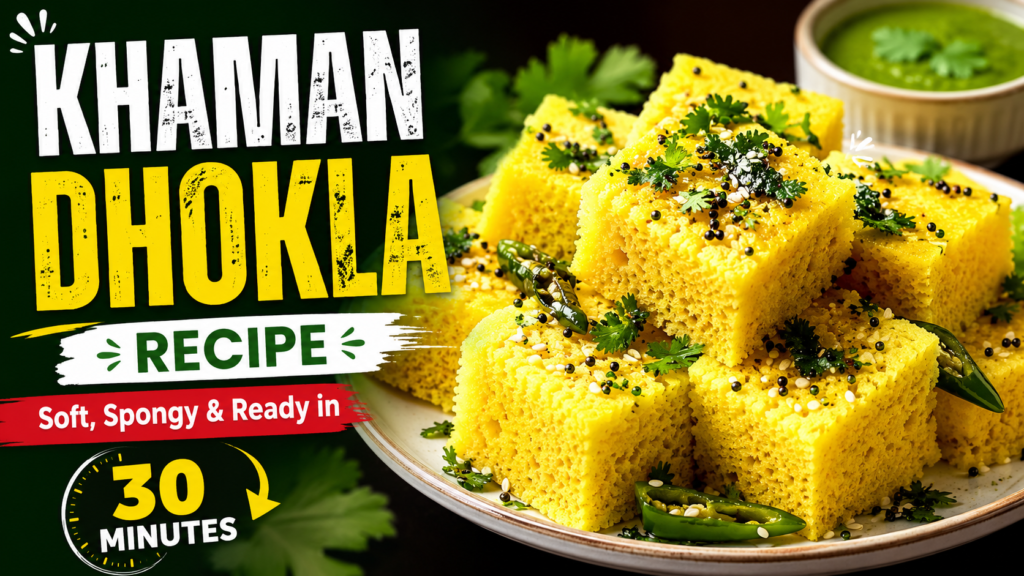
Khaman Dhokla Recipe: Soft, Spongy & Ready in 30 Minutes
By Kaushik Brahmakshatriya
Published On 02 June 2026.
Khaman Dhokla Recipe
Khaman Dhokla is one of Gujarat’s most beloved street foods — a soft, pillowy, mildly tangy steamed cake made from fermented or instant chickpea flour (besan) batter. Unlike its cousin the regular dhokla made with rice and lentil batter, khaman uses 100% besan, giving it a denser yet airy crumb and a brighter golden colour. Whether you serve it as a morning snack, an afternoon tea companion, or a light party starter, this recipe delivers consistent results every single time.
What makes this version special is the use of citric acid (nimbu ka phool) alongside baking soda, which creates an immediate fizz in the batter — that fizz is responsible for the signature spongy holes inside each slice. No fermentation wait time, no complicated equipment. Just a steamer and 30 minutes.
Instant No Fermentation High Protein Gluten Free
Ingredients at a Glance
Khaman Dhokla Ingredients (Serves 4–6)
| Category | Ingredient | Quantity | Note |
| Batter | Besan (Chickpea Flour) | 1½ cups | Sifted, lump-free |
| Batter | Semolina (Rava/Suji) | 2 tbsp | Adds bite & body |
| Batter | Water | ¾ cup | Room temperature |
| Batter | Lemon Juice | 1½ tbsp | Freshly squeezed |
| Batter | Sugar | 1 tsp | Balances sourness |
| Batter | Salt | ¾ tsp | To taste |
| Batter | Turmeric Powder | ½ tsp | For colour |
| Batter | Ginger Paste | ½ tsp | Freshly grated preferred |
| Batter | Green Chilli Paste | ½ tsp | Adjust for heat |
| Leavening | Eno (Fruit Salt) | 1 tsp | Add last, just before steaming |
| Tempering | Oil | 2 tbsp | Neutral oil or groundnut |
| Tempering | Mustard Seeds | 1 tsp | For tadka |
| Tempering | Curry Leaves | 8–10 | Fresh |
| Tempering | Green Chillies, slit | 2–3 | Whole, for aroma |
| Tempering | Sugar + Water Mix | 1 tsp + 3 tbsp | For moist finish |
Garnish | Fresh Coriander | 2 tbsp, chopped | Finishing touch |
| Garnish | Grated Coconut | 2 tbsp | Optional, traditional |
Step-by-Step Method
1. Sift the besan into a large mixing bowl. Add semolina, salt, sugar, turmeric, ginger paste, and green chilli paste. Mix well until evenly combined.
2.Gradually pour in lemon juice and water. Whisk the batter to a smooth, lump-free consistency — roughly the thickness of a medium pancake batter. Let it rest for 5 minutes.
3.Prepare your steamer: fill a large pot with 2 inches of water and bring it to a rolling boil. Grease a round 7–8 inch cake tin or thali generously with oil.
4.Just before pouring: add Eno fruit salt to the batter and immediately stir in one direction for 20 seconds. The batter will froth and expand — this is exactly what you want. Do NOT over-mix.
5.Pour the activated batter into the greased tin immediately. Place it in the steamer, cover with a lid, and steam on high heat for 15–18 minutes. Insert a toothpick — it should come out clean when done.
6.Let the dhokla cool for 5 minutes before running a knife around the edges. Flip gently onto a plate, then flip again so the golden top faces up. Cut into squares or diamonds.
7.For tempering: heat oil in a small pan. Add mustard seeds and let them splutter. Add curry leaves and slit green chillies. Pour the sugar-water mix into the pan, let it sizzle for 10 seconds, then drizzle the entire tempering evenly over the cut dhokla pieces.
8.Garnish with fresh coriander and grated coconut. Serve with green chutney or tamarind chutney.
Pro Tip: The moment you add Eno, the clock starts. Have your steamer already at full boil, tin already greased, and pour the batter within 60 seconds of adding the Eno. Any delay means the gas escapes and your dhokla turns flat and dense.
Recipe Time & Nutrition Overview
Time Breakdown & Approximate Nutrition (Per Serving)
| Parameter | Details |
| Prep Time | 10 minutes |
| Steaming Time | 15–18 minutes |
| Resting & Tempering | 7–8 minutes |
| Total Time | ~30 minutes |
| Calories (approx.) | 145–160 kcal |
| Protein | 6–7 g |
| Carbohydrates | 22–25 g |
| Fat | 4–5 g |
| Fibre | 2–3 g |
| Best Served With | Green chutney, tamarind chutney, masala chai |
Popular Khaman Dhokla Variations
Regional & Modern Variations of Khaman Dhokla
| Variation | Key Difference | Best For |
| Classic Khaman | 100% besan batter, Eno leavened | Everyday snacking |
| Surti Khaman | Slightly coarser, less sweet tempering | Surat street-food lovers |
| Sandwich Dhokla | Green chutney spread between two layers of batter | Party starters, lunchboxes |
| Moong Dal Khaman | Yellow moong dal replaces part of besan | Lighter, easier-to-digest option |
| Schezwan Khaman | Schezwan sauce used in tempering | Fusion snack lovers |
| Microwave Khaman | Microwaved instead of steamed (4–5 min) | Quick weekday snack |
Frequently Asked Questions (FAQ)
Q1. Why did my Khaman Dhokla turn out dense and not spongy?
The most common reason is delayed steaming after adding Eno. Once Eno is mixed into the batter, it triggers an instant chemical reaction that creates CO₂ bubbles — those bubbles are what make the dhokla light and airy. If you wait too long before putting the tin in the steamer, those bubbles escape and the batter collapses. Always have your steamer at full boil before you add Eno, and pour and steam within 60 seconds.
Q2. Can I make Khaman Dhokla without Eno fruit salt?
Yes. You can substitute Eno with a combination of ½ tsp baking soda and ½ tsp citric acid (nimbu ka phool). The reaction is slightly less vigorous than Eno, so the final texture may be marginally less fluffy. Another traditional approach is to ferment the batter overnight with a small amount of curd — this produces a more complex sour flavour but requires planning ahead.
Q3. Is Khaman Dhokla the same as regular Dhokla?
No — this is one of the most common misconceptions about Gujarati cuisine. Regular dhokla (also called Gujrati dhokla or white dhokla) is made from a fermented batter of rice and split black gram (urad dal). Khaman dhokla, on the other hand, uses only besan (chickpea flour) and is usually instant. The texture, taste, and colour are noticeably different. Khaman is yellower, more tangy, and quicker to prepare.
Q4. How do I store leftover Khaman Dhokla and reheat it properly?
Store leftover dhokla in an airtight container in the refrigerator for up to 2 days. To reheat, avoid the microwave if possible — it tends to make the texture rubbery. Instead, place the pieces in a steamer for 3–4 minutes to bring back the original soft texture. You can also heat a pan with a few drops of water, cover it, and warm the dhokla on low heat for 2 minutes. Never store with the tempering on top if planning to keep it overnight.
Q5. What chutney goes best with Khaman Dhokla?
Khaman dhokla is traditionally served with a bright, fresh green coriander-mint chutney that cuts through the richness of the besan and complements the tangy notes in the dhokla. Tamarind-date chutney (imli chutney) is the other popular pairing — its sweet-sour profile works especially well when the dhokla itself is lightly spiced. In many Gujarati homes, both chutneys are served side by side so you can mix as you like.
Q6. Can Khaman Dhokla be made in an Instant Pot or pressure cooker?
Absolutely. For a pressure cooker, remove the whistle and the rubber gasket, add 2 cups of water, and bring it to a boil. Place a stand inside, set the greased tin on the stand, cover with the lid (no whistle), and steam on medium-high heat for 15–17 minutes. For the Instant Pot, use the Steam setting with the steam release valve open (venting position). The results are excellent and very consistent.
Serving Suggestions & Pairing Ideas
Khaman dhokla is a deeply versatile dish. Serve it warm as a morning breakfast with a cup of masala chai, pack it as a lunchbox snack for children, or cut it into smaller pieces and serve it as a party appetizer. For a full Gujarati breakfast spread, pair it alongside fafda, jalebi, and a small bowl of papaya. It also works beautifully as a light dinner when served alongside dal and steamed rice.
For presentation, cut the dhokla into uniform diamonds rather than squares — it photographs better and gives the platter a festive, celebration-ready look. A final sprinkle of pomegranate seeds alongside coriander adds colour and a surprise burst of sweetness that guests always appreciate.
