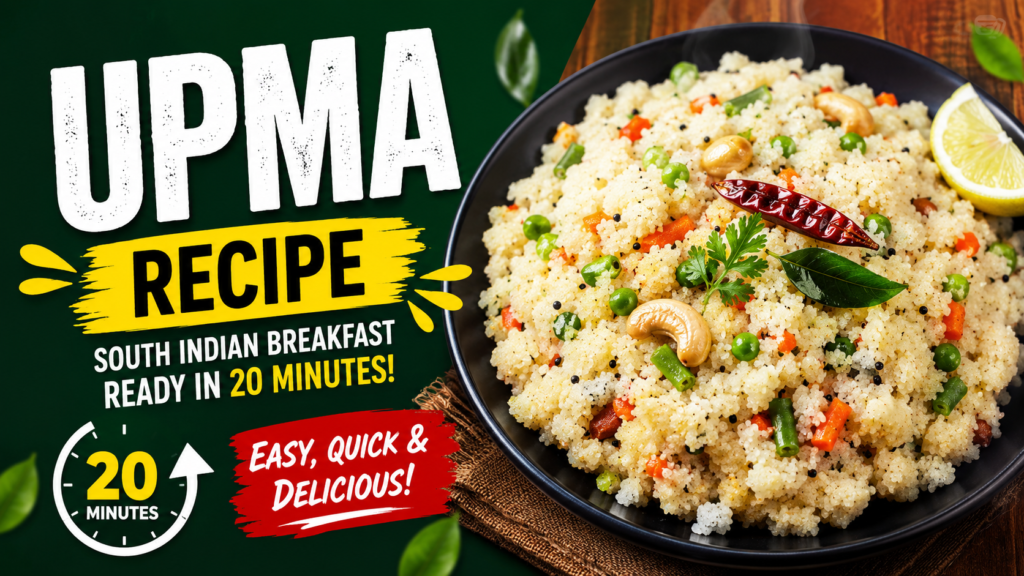
Upma Recipe: The Perfect South Indian Breakfast You Can Make in 20 Minutes
By Kaushik Brahmakshatriya
Published On 28 May 2026.
Upma Recipe
Introduction
Every great morning deserves a great breakfast. Upma — the humble South Indian classic made from roasted semolina — has fed millions of Indian families for generations, and for very good reason. It is warm, filling, nutritious, and incredibly easy to prepare. Whether you are rushing out on a busy weekday morning or enjoying a relaxed Sunday brunch, Upma fits every occasion perfectly.
Known as Rava Upma or Sooji Upma across different Indian regions, this dish carries a comforting, nutty aroma that immediately makes the kitchen feel alive. With just a few pantry staples — semolina, onions, mustard seeds, and curry leaves — you can create a wholesome breakfast that satisfies both the stomach and the soul.
In this blog post, you will find the complete Upma recipe with ingredients, step-by-step method, nutritional details, pro tips, and answers to the most common questions home cooks ask. Let’s get started!
What Is Upma?
Upma is a savory porridge-style dish made by cooking roasted semolina (also called rava or sooji) with water, tempered spices, and vegetables. It originated in South India but has spread across the entire country and is now a beloved breakfast in Tamil Nadu, Karnataka, Kerala, Andhra Pradesh, and even Maharashtra.
The beauty of Upma lies in its flexibility — you can make it plain and simple or load it with vegetables like carrots, peas, beans, and tomatoes. Some people even add cashews for a rich crunch. It is naturally vegetarian and can easily be made vegan by skipping ghee and using oil instead.
Ingredients for Upma (Serves 3–4)
| Ingredient | Quantity | Notes |
| Semolina (Rava / Sooji) | 1 cup | Coarse or medium variety |
| Water | 2.5 cups | Hot or room temperature |
| Onion (medium, chopped) | 1 | Finely diced |
| Green chilies | 2 | Slit lengthwise |
| Ginger | 1 tsp | Freshly grated |
| Mustard seeds | 1 tsp | For tempering |
| Chana dal | 1 tbsp | Adds texture and crunch |
| Urad dal | 1 tsp | Optional but recommended |
| Curry leaves | 8–10 | Fresh preferred |
| Carrot (chopped) | ¼ cup | Optional vegetable |
| Green peas | ¼ cup | Fresh or frozen |
| Oil or Ghee | 2 tbsp | Ghee enhances flavor |
| Salt | To taste | — |
| Lemon juice | 1 tsp | For freshness at the end |
| Cashews | 8–10 | Optional, for garnish |
| Fresh coriander | 2 tbsp | For garnish |
Step-by-Step Method
Step 1 — Dry Roast the Semolina
Place a heavy-bottomed pan on medium heat. Add the semolina and dry roast it for 5 to 7 minutes, stirring continuously, until it turns light golden and releases a nutty fragrance. Do not let it brown too deeply. Transfer to a plate and set aside. This step is the most important one — properly roasted semolina gives Upma its signature texture and prevents it from becoming lumpy.
Step 2 — Prepare the Tempering
In the same pan, heat oil or ghee over medium flame. Once hot, add mustard seeds and let them splutter. Then add chana dal and urad dal, and fry for about 1 minute until they turn light golden. Add cashews now if using them, and let them toast briefly.
Step 3 — Sauté the Aromatics
Add curry leaves — be careful as they splutter. Then add green chilies and grated ginger. Sauté for 30 seconds. Add the chopped onions and cook until they become soft and translucent, roughly 3 to 4 minutes.
Step 4 — Add Vegetables
Add carrots and green peas. Stir well and cook for 2 minutes until slightly softened. Season with salt.
Step 5 — Add Water
Pour in the water and increase the flame to bring it to a boil. Taste and adjust salt at this point.
Step 6 — Add Semolina
Reduce the flame to low. Slowly pour the roasted semolina into the boiling water with one hand while stirring continuously with the other. This prevents lumps from forming. Mix well, cover the pan, and cook for 3 minutes on low flame.
Step 7 — Finish and Serve
Open the lid, stir once more, and squeeze in fresh lemon juice. Garnish with chopped coriander. Serve hot with coconut chutney, pickle, or a cup of masala chai.
Upma Nutritional Information (Per Serving — Approx.)
| Nutrient | Amount |
| Calories | 210 kcal |
| Carbohydrates | 32 g |
| Protein | 6 g |
| Fat | 7 g |
| Dietary Fiber | 3 g |
| Sodium | 280 mg |
| Iron | 8% DV |
| Vitamin C | 12% DV |
Pro Tips for the Best Upma Every Time
- Always roast the rava first. Unroasted semolina turns sticky and mushy. Roasting is non-negotiable.
- Use hot or warm water. Adding hot water to the pan speeds up cooking and reduces the chance of lumps.
- Stir while adding semolina. Never dump the rava all at once into the water — add it gradually in a steady stream.
- Rest for 2 minutes after cooking. Covering the pan after mixing and resting it off the flame allows steam to finish the cooking and makes Upma fluffy.
- Add lemon juice only at the end. Cooking lemon juice makes it bitter — always squeeze it fresh before serving.
Upma Variations You Can Try
| Variation | Key Ingredient Added | Flavor Profile |
| Vegetable Upma | Mixed vegetables (carrot, beans, peas) | Wholesome and colorful |
| Tomato Upma | Chopped tomatoes added while sautéing | Tangy and bright |
| Coconut Upma | Fresh grated coconut folded in at the end | Rich and mildly sweet |
| Poha Upma | Flattened rice instead of semolina | Lighter texture |
| Oats Upma | Rolled oats replace rava | High-fiber, healthy twist |
| Bread Upma | Cubed bread pieces added | Quick and kid-friendly |
Frequently Asked Questions (FAQ)
Q1. Can I make Upma without onion and garlic?
Yes, absolutely. Skip the onions and replace the green chili sauté with just ginger and curry leaves. This version is suitable for those who follow a sattvic or Jain diet. The flavor remains excellent because the tempering of mustard seeds and dals does most of the aromatic work.
Q2. Why does my Upma turn out lumpy?
Lumpy Upma is almost always caused by one of two mistakes — skipping the dry roasting step, or adding semolina to cold water all at once. Always roast the rava before cooking, bring the water to a full boil before adding the semolina, and stir continuously as you pour it in.
Q3. How long can I store Upma?
Upma tastes best fresh and hot. However, you can refrigerate leftover Upma in an airtight container for up to 1 day. When reheating, sprinkle a little water over it and heat in a pan on low flame or in a microwave for 1 to 2 minutes. Avoid storing it beyond 24 hours as the texture changes significantly.
Q4. Is Upma healthy for weight loss?
Semolina is a good source of complex carbohydrates and protein, making Upma moderately filling. To make it more weight-loss friendly, reduce the oil to 1 teaspoon, skip the cashews, and load it with vegetables. Oats Upma is an even lighter alternative with more fiber.
Q5. What can I serve with Upma?
Upma pairs beautifully with coconut chutney, green mint chutney, tomato pickle (thokku), a small bowl of plain yogurt, or a hot cup of filter coffee or masala chai. In South Indian homes, it is also served with a side of banana for a complete breakfast.
Q6. Can I make Upma without a wok or kadai?
Yes, any heavy-bottomed pan with a lid works well. A non-stick saucepan or a stainless steel pot both give good results. Just make sure the base is thick to prevent the semolina from sticking or burning.
Final Thoughts
Upma is one of those rare dishes that is effortless to make, endlessly customizable, and never gets boring. With the right technique — properly roasted semolina, a punchy tempering, and a final squeeze of lemon — it transforms from a simple grain into a truly satisfying breakfast. Once you get comfortable with the base recipe, you can experiment with different vegetables, regional spice variations, or even fusion twists.
